
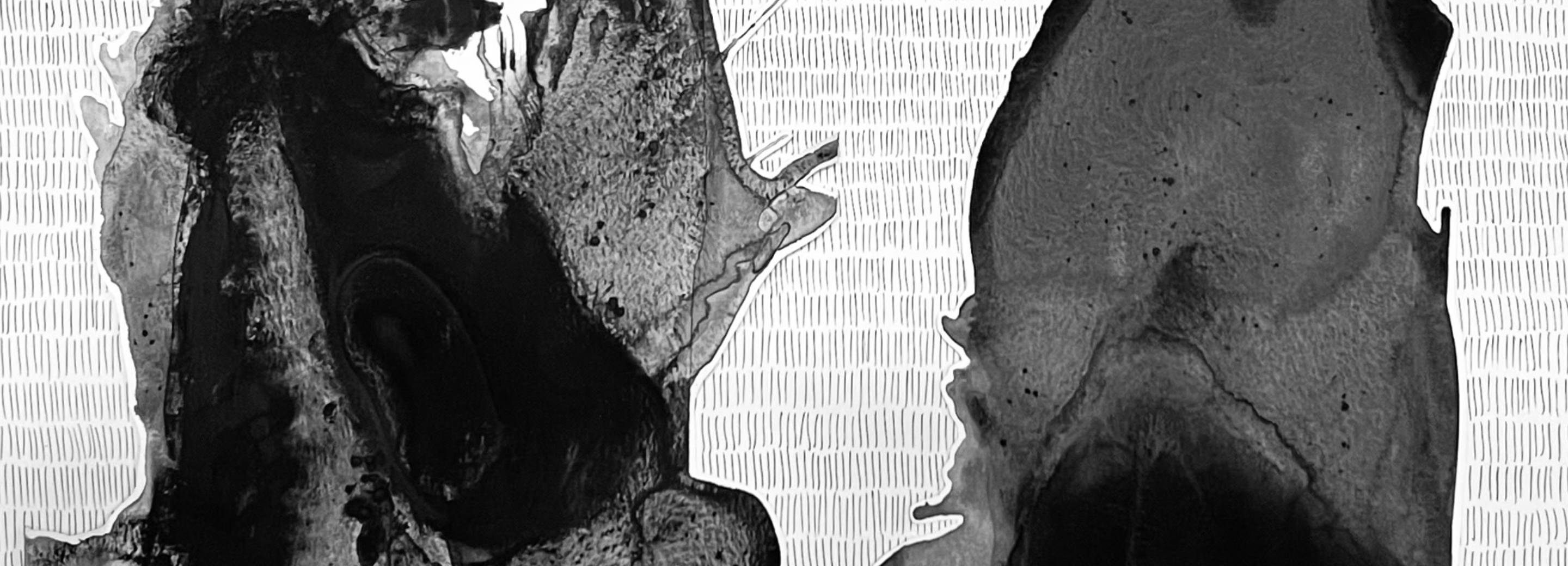
REEM MASRI: TIME OF MONSTERS
Curated by Zasha Colah and Francesca Verga
Opening: November 25, 2026, 7:30 pm.
Time of Monsters traces an intense line through Reem Masri’s practice from 2016 to 2026. In the exhibition, body and land emerge as vulnerable terrains that can be occupied, altered, carved, and contested. Masri brings bodily and territorial experience into relation without collapsing their differences, approaching both as spaces in which violence, memory, and persistence are inscribed. From the lightness of the translucent surfaces of Occupied Land, Occupied Body (2018) to the density of the more recent paintings, from the fragmentation of bodies in Time of Monsters (2024) to the more essential forms of the recent works, what perhaps remains constant
is the vulnerability of that which should be inhabitable. In Masri’s work, what resists is perhaps, above all, the very act of making: recomposing parts without pretending that the fracture has disappea- red. Imagination does not restore access to a place, reconstitute a body as it was before illness, or undo the violence of history. It can, however, deprive that violence of its monopoly over form, preventing it from being the only force that determines what remains visible and what can still be thou- ght. The time of monsters is not necessarily a time without images: it is, perhaps, a time when it becomes necessary to inhabit them once again, precisely because no image can any longer claim to be innocent.
Reem Masri is a Palestinian visual artist, born in Jerusalem in 1991, whose practice spans painting, drawing, collage, and installation. She is a part-time instructor at Birzeit University’s Faculty of Art, Music and Design, in Ramallah.
Event: Lecture by Reem Masri and Yasmin Riyahi. Discussion moderated by Davide Ferrando.
November 23, 2026, 6-8 pm.
Venue: Aula F6, Main Campus of Free University of Bozen-Bolzano (unibz)
Address: Piazza Università 1, 39100 Bolzano
On November 23, Reem Masri will give a lecture on her artistic practice and teaching she conducts in Palestine. Yasmin Riyahi, postdoctoral fellow at the Kunsthistorisches Institut in Florence, will engage in a dialogue with her, drawing on her own research into the reception of contemporary Palestinian art in Italy. The conversation will be followed by a discussion moderated by Davide Ferrando, architecture critic, curator, and Associate Professor at the Faculty of Design and Art at the Free University of Bozen-Bolzano. The event is co-organised between Ar/Ge Kunst and the Free University of Bozen-Bolzano with the assembly South Tyrol Knowledge Workers for Palestine and Peace.
Bio
Reem Masri (b. 1991, Jerusalem) is a Palestinian visual artist whose practice explores the relationship between land, memory, and self-identity through painting, drawing, collage, and installation. She holds an MA in Contemporary Art from ENSA Bourges, France, and has taught at the Faculty of Art, Music and Design at Birzeit University. In November 2026, Time of Monsters at Ar/Ge Kunst will mark her first solo exhibition in Italy.
Yasmin Riyahi is an art historian and postdoctoral fellow at the Kunsthistorisches Institut in Florenz, Max-Planck-Institut. Her research focuses on contemporary Palestinian art, exhibition histories, and transcultural exchanges. Her current project, Visioning Palestine, examines the reception of Palestinian art and visual culture in Europe from the 1970s to the 2000s.
South Tyrol Knowledge Workers for Palestine and Peace is a group of people working at the Free University of Bolzano Bozen and at Eurac Research. They seek to highlight the critical aspects of the official agendas and policies of both institutions' which include collaborations with the defense industry and the limited opportunities for open debate within official channels. The assembly participates in working groups addressing inclusion, humanitarian corridors, demilitarization of academic research, academic freedom and the right to dissent. It also (co)organizes events offering in-depth discussion of the Palestinian question, the genocide in Gaza, and research ethics.